Seiten Wall – Veneno Libre
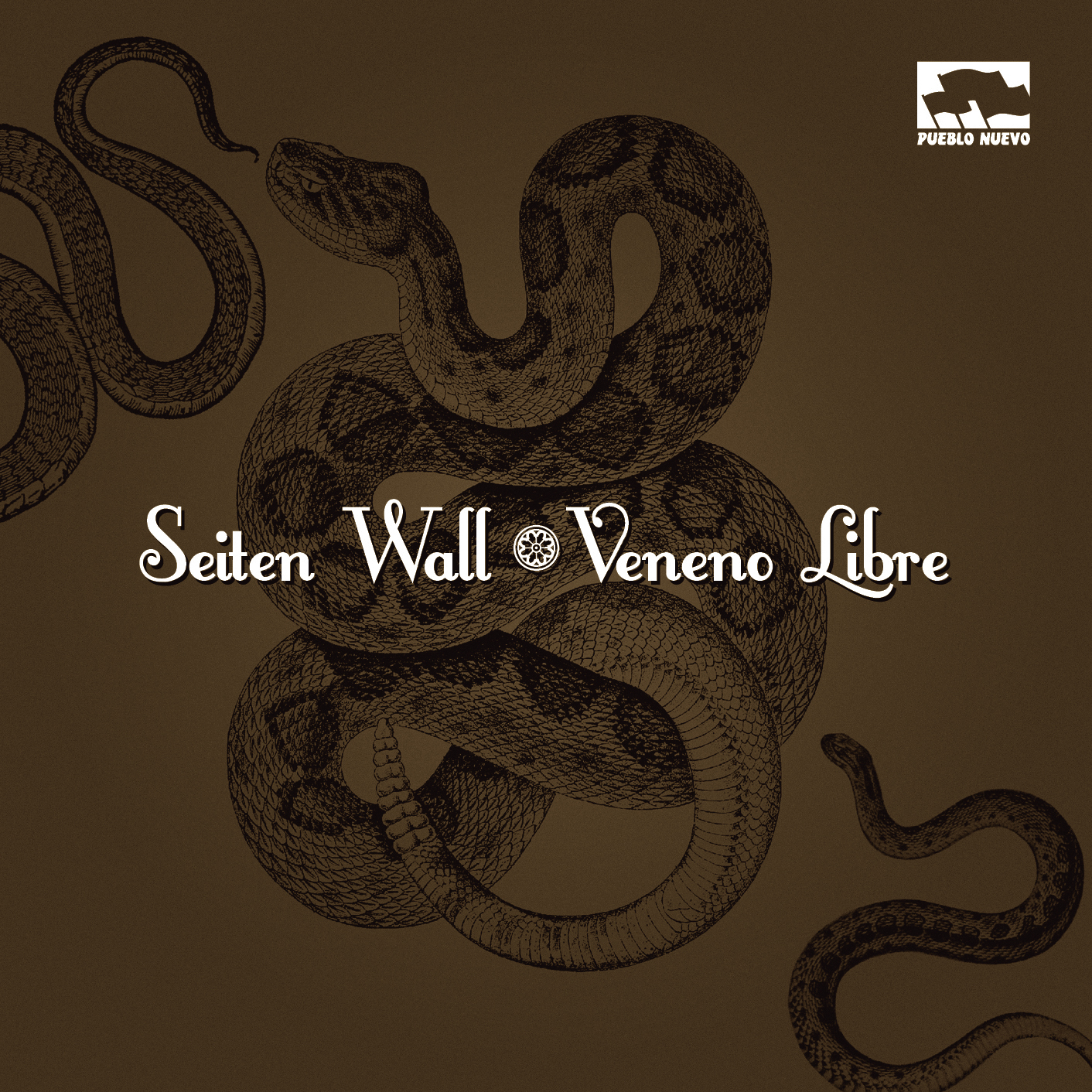
Seiten Wall
“Veneno Libre”
THE INDIESCREET CHARM OF THE LEAP INTO THE VOID
(& THE CONSEQUENT TUMBLE)
Each work by the musician and composer Ricardo Tapia (Santiago RM, 1991) constitutes an experience in itself. Not only because of the multiple spaces and aliases he engages, but also through an almost permanent impossibility of anticipating the result. Nevertheless, a panoramic observation of his catalog allows us to distinguish certain inclinations or tendencies, better understood as an emphasis on a certain spectrum or stereo channel, just as an uncalibrated turntable would do in playing some record. This inclination enables a particular listening experience, arranged from that obscuration mentioned by Les Luthiers in “La bossa nostra” (1973)[1].
Like any composer born at the end of the 20th century, Ricardo carries a particular disposition to encompass a constantly expanding sonic environment – that is, increasingly saturated with information, storage technologies and timbres / colors. This can make it difficult to access the totality or corpus of the trajectory to be covered from what he draws or announces at the outset. On the contrary, we instead find ourselves with scraps, bits, zapping and clippings that intersect, interface[2] and metamorphose into the unspeakable, devoid of all control, prompting us to «turn off the mind, relax and float downstream» or to leave «running for our lives, if we can”[3].
In this sense, his complete work is an offering analogous to the aesthetics of the New York radio station WFMU, which does not seek to keep the listener captive, but to test the listener to the point of exasperation, to the point of turning off the radio or changing stations. In the case of “Veneno Libre” (Free Venom), we find a plunderphonic approach that is not afraid to approach from the Latin American perspective those areas of exasperation present in works like those of the concept’s originator (the Canadian John Oswald[4]) or in works by visual artists such as Britain’s Vicki Bennett (aka People Like Us).
The material taken can be manipulated or not, in an act of not doing (laissez-faire) usually punished by compositional schools that castigate the pleasure of “doing nothing”, as laziness that must be eradicated like the plague. The routes that originate these pieces constitute trial and error in its purest state, an approach also punished by these and other schools. In this transit, the tumbles do not cease to be and must be felt, with the greatest force, surpassing those alluded to by Carlos Cabezas Rocuant in “El frío misterio (The Cold Mystery)” (1987), becoming “honorable scars of war”, as is sung in one of the first stereophonic records recorded in Chile[5].
Thus, jumping into the void with the vocation of a stunt double, channeling as much reference as he is capable of amplifying, erasing stylistic boundaries with his computer like a child armed with pencils and university notebooks – and, incidentally, throwing the whole world on top, in -voluntarily-, Ricardo Tapia, in his Seiten Wall character, presents himself to us as a local counterpart of the beloved Rubén Albarrán, as a counter-mirror to the Chilean-German Uwe Schmidt, pushing as far as he can the always correct limits of the local sonic musical scene.
[1] See https://lesluthiers.org/verobra.php?ID=42 and https://youtu.be/RsoeDiu8veg. Accessed October 25, 2020.
[2] See the interview with Luis Alberto Spinetta (1950-2012) conducted in Santiago RM by Nelson Peña González in 1986 (minute 22 and forward): https://archive.org/details/lasintrvws/. Accessed October 25, 2020.
[3] Excerpts from “Tomorrow Never Knows” (1966) and “Run For Your Life” (1965), respectively.
[4] See his essay “Plunderphonics, or Audio Piracy as a Compositional Prerogative” (1985) in http://plunderphonics.com/xhtml/xplunder.html. Accessed October 25, 2020.
[5] Excerpts from “Los viejos estandartes”, (1966), track B1 from the Los Cuatro Cuartos album ¡Al “7° De Línea”!. See https://www.discogs.com/Los-Cuatro-Cuartos-Al-7-De-L%C3%ADnea/release/4795083. Accessed October 25, 2020.
Gerardo Figueroa Rodríguez
(Maipú, Chile. 25 octubre 2020, horas antes de votar #apruebocc / October 25 2020, hours before voting #apruebocc)