Various Artist – Earsheltering: 20 years of noise – RV 666
Various Artist
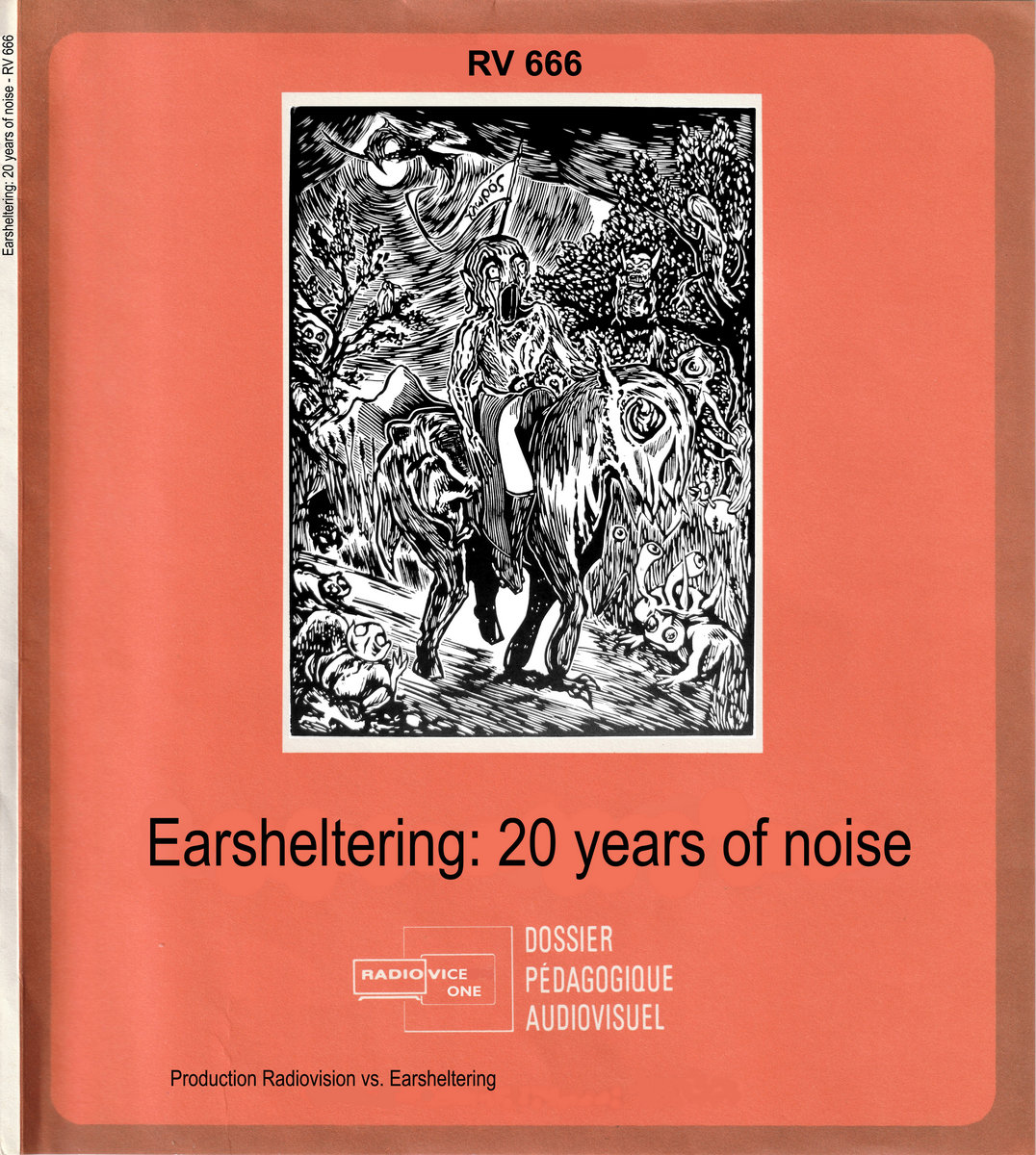
“Earsheltering: 20 years of noise – RV 666”
Radiovision vs. Earsheltering
EARSHELTERING: 20 years of noise
earsheltering celebrates is 20th anniversary in 2024 with a various artists release as a tribute to RADIOVISION.
Thanks to all artists & friends who supported this project & also EARSHELTERING since 20 years, especially Alkbazz providing a wonderful artwork within short timelines & Françis Baume for Amazing sampling from Radiovision to create interludes between each tracks.
The release is available as a free virtual double disc available on archives & bandcamp(s). Disc 1 is dedicated to Radiovision serie and disc 2 is dedicated to Radiovision Eveil serie.
1 video clips by CorteX is also made available.
Radiovision is an educational program which was launched in 1955, combining a school radio program with a slide show and a booklet. Forgotten today, it was a great success until the 1980s.
The slideshow and booklets were received on request by schools a few weeks before the radio program was broadcast. The colored slideshow pictures were larger and in a higher definition than the television image could offer. Paintings, engravings, manuscripts and old photographs were rendered with a higher quality than television couldn’t reach. It was therefore particularly useful for Geography, History of Arts and Natural Sciences classes.
The teacher had to manually ensure synchronization between images and sounds, triggering the transition to the next slide at each the sound signal.
During the 70s, in addition to the combination of sounds and still images, radiovisions became part of a more complete multimedia system, from an educational and tools point of view, and made up the radiovisual file. Each week, two programs from the “Radio-awakening” series would be associated with the radiovision, developing complementary aspects of the subject dealt with, along with educational documents gathered together in a file (15 to 20 pages of program content analysis, bibliography, texts, photographs, maps, etc.).
From the 1974-75 school year onwards, a flexy 7 inch disk would be part of the package for a few files, and then it developed to become more systematically; in the 80s, audio cassettes took over the flexy 7 inch disk.