about

Since 2010, many netlabels and artists publish their new free music releases on the clongclongmoo website. Free means that you don't have to pay anything or register to download music. However, you can usually pay something to support the artists. Please note the licenses under which the music is published. This is important to know what you are allowed to do with the music. Please visit the labels' homepages to get the free music. Most files are published under a creative commons licence. At netlabellist you will find an extensive list of websites that also offer (or have offered) free music. If you run a netlabel yourself or offer your music for free and want to draw attention to it, you are welcome to use the submission form. And remember that clongclongmoo is not there to do business, because “Business Is Not My Music.”

update, February 1st, 2026

Dear friends and followers of clongclongmoo. It's great to have you here. As you may have noticed, the site has changed a bit. Some people wanted to be able to access the music with fewer clicks. That should work again now. Here's a quick note to everyone who uses relatively new platforms such as Mirlo, Faircamp, or Coop: feel free to use the submit form to draw attention to your new music. I'd especially appreciate hearing from anyone who runs a netlabel with free Creative Commons music. Thank you! Konrad from clongclongmoo

music tagged with: sampling

Fields Ohio – Litha

Fields Ohio – Litha

Fields Ohio

“Litha”

While searching for the light that kills the bacteria
they found a light that reprograms the cells,
a light that rewrites the souls,
and a light that travels nowhere
except it’s everywhere.

And while they were at it
they had to consider proportionate
quantum integers that existed
on the other
side of the worm hole,
-)))That swirling mass that spins faster
than the speed of any light
so quickened by madness at onehundred&eightysevenmillionmilespersecond that it traps
light and anything else in sight
in order to deconstruct, to pull a part the atoms and reconfigure,
like the mouth of Pluto
sucking our dear Persephone into the crust
into the depths of the earth itself,
the blackness was all consuming
til her mother scorched the soil with revenge
and Pluto freed her but with some leverage
to bring life back and repair the burns and then in winter she returns.
Her sacred release brings our pomegranate
lips that yearned for Spring bliss,
a well intact rite of atonement
earned in the winter drifts for those who survive it.

So do the blackholes too transform and release the
light to some flipped compartment of space and time?
Do the particles ride through and bring light to
another side?
These were the questions they began to ask
as humanity looked back with a vast flabbergast,
they had exacerbated the fresh water which all life has a constant need,
the land became void of air giving trees,
all beginning with the lust for greed.
But we have not done this, you and I nor my neighbor down the street,
How can we be held responsible for changing the way we all see?
And then as though a light bulb had gone off above them,
everything clicked. Our old ways must be swallowed by generations
who detest the exploitation of the needy. The future is only foreboding if we allow for
the greedy to succeed.
The darkness must transform the light and in this yinyang eddy
they found their peace.
credits
released June 20, 2021

Button: by-sa
posted 20 June 2021

Numa Gama – Memorias de Oneyda

Numa Gama – Memorias de Oneyda

Numa Gama

“Memorias de Oneyda”

Memórias de Oneyda was created during the residency held by São Paulo Cultural Center (CCSP) in celebration of the 85th birthday of the public record library “Discoteca Oneyda Alvarenga” which has one of the biggest archives of latin america and is named after the director and founder Oneyda Alvarenga.

Percussions, beats, harmonic layers, and almost all details were extracted solely from the vast collection of the library, with exception of a few field recordings and instrumentals I’ve recorded for other occasions. These additional audios are also used as sound collage. I took most of the vocals from the historical 1938’s folklore research mission, which aimed into recording traditional music from the north and northeast of Brazil.
I’ve adapted the sonority of the tracks to the quality and texture of the oldest recordings, seeking a sound in between contemporary and a 30’s recording – as it was an old dirty recording of a parallel reality. The são paulo musician and engineer Bruno Palazzo helped me to enhance this feeling with an analog tape master.

Minimum suggested donation is 5.50€ + vat. 50% of the profits will be donated to the movement of the indigenous woman of Xingu – ATIX Mulher. Depending on how much is raised, other indigenous ONGS will be included.

released February 4, 2021

Criação e Mixagem: Numa Gama
Design: Numa Gama
Masterização: Bruno Palazzo
Fonte desenhada: Clau Smith

Button: by-nc-sa
posted 07 June 2021

Gerardo Figueroa Rodriguez – 6×216 Mixtape

Gerardo Figueroa Rodriguez – 6×216 Mixtape
[pnmxt006]

Gerardo Figueroa Rodriguez

“6×216 Mixtape”

“…6×216 es el vivo ejemplo de que el arte proceso no siempre se materializa en un resultado desprolijo. Por el contrario, la metodología matemática del autor para interpolar el material parte desde el cuidado por la calidad sonora. Es esta característica lo que da valor a los experimentos de Christian Marclay y a la técnica de Grandmaster Flash. El proceso le otorga una forma a la música, pero es la aproximación de Figueroa la que, en este caso, nos hace encontrar un acróstico sonoro escondido en más de una década de música electrónica chilena…”

“…6×216 is the living proof that process art does not always materialize in a snevering result. Au contraire, the auteur’s mathematical methodology for interpolating material is based on sound quality care. It is this feature that makes Christian Marclay’s experiments and Grandmaster Flash technique valuable. Process shapes music, but it is Figueroa’s approach which, in this case, leads to a sound acrostic hidden in more than a decade of Chilean electronic music…”

Emilio Adasme Campos
Compositor / Composer
Comunidad Electroacústica de Chile (CECH)
(Santiago, Chile. Abril / April 2021)

“…Lo interesante es que en este frenético y denso viaje hay una coherencia musical. La electroacústica, el ruido, las grabaciones de campo, la música concreta y la música de baile conviven, mostrando tanto una evidente fragmentación como una elegante integración. Invita al receptor a entrar en un estado de atención, abrir los oídos, atrapar detalles, reconocer o creer reconocer samples, separar y conectar sonidos, pero invita también a recorrer el catálogo de Pueblo Nuevo.

“El mixtape presenta una imagen panorámica de la libertad con que el sello ha construido su catálogo. El cruce de géneros musicales, la inclusión de la calle y la academia, de consagrados y emergentes, son temas que están en la genética de Pueblo Nuevo y el mixtape los expone…”

“…The interesting thing here is the musical coherence behind this frantic, dense journey. Electroacoustic music, noise, field recordings, musique concrète, and dance music coexist, showing both an evident fragmentation and an elegant integration. It invites the receiver to an attentive state, ears opened, grabbing details, recognizing – or making believe to – samples, separating and connecting sounds, thus going through Pueblo Nuevo catalog.

“The mixtape presents a panoramic picture of the freedom the netlabel has made its catalog with: crossing over genres, grassroots and academy alike, well-known and rookies, embedded in Pueblo Nuevo’s DNA – all of which this mixtape unveils…”

Osvaldo Sotomayor Rojo
(Santiago, Chile. Abril / April 2021)

“…¿Es posible condensar 15 años de historia de Pueblo Nuevo, en apenas tres minutos y medio de música? Tal como un mago que generosamente enseña sus trucos, en las propias notas de programa el autor entrega interesantes detalles de cómo logró dicha hazaña, explicando de manera exhaustiva la metodología utilizada, la cual demuestra una planificación rigurosamente intelectual y, sin embargo, sugiere una apertura y disposición a dejar que el “azar” intervenga de manera libre y espontánea en el desarrollo de la obra. Lo que a primeras luces pareciera ser una evidente contradicción entre intelecto e intuición, resulta más bien ser un perfecto equilibrio entre mente y corazón, lo cual me lleva a pensar en el hecho de que el azar, como tal, no existe en ninguna experiencia de vida, si no que en realidad los hechos se suceden en un devenir de sincronicidad, en donde, a un nivel más profundo, todo está conectado de alguna forma invisible pero claramente palpable. Con esa disposición en mente, Gerardo Figueroa Rodríguez estableció un método de trabajo en el que dejó, de manera consciente e inconsciente, espacio para que la propia obra, en definitiva, fuera mostrando la pauta de cómo se iba armando a sí misma, convirtiéndose el autor en un instrumento o canal, más que un creador de “pleno derecho”. De esta manera Figueroa busca llevar al mínimo su propio sesgo personal: es como si intentase dar un paso al costado, actuando de manera casi invisible. Aún así, el sólo hecho de adoptar esa actitud constituye un sello en sí mismo, ineludible y propio del autor, lo cual entrega a este mixtape la categoría de obra musical autoral en sí misma…”

“… Is it possible to condense 15 years of Pueblo Nuevo history into just three and a half minutes of music? Like a magician who generously teaches his tricks, the liner notes provide interesting details of how the auteur accomplished this feat, exhaustively explaining the methodology used, demonstrating a rigorously intellectual planning and, yet, suggesting an openness and willingness to let “chance” freely and spontaneously intervene in the work unfolding. What at first glance seems an obvious contradiction between intellect and intuition, turns into a perfect mind and heart balance, leading me to think that chance, as such, does not exist in any life experience, but facts happen in a true becoming of synchronicity, where, on a deeper level, everything is connected in some invisible but clearly palpable way. This willingness in turn allowed Gerardo Figueroa Rodríguez to establish a working method which, consciously and unconsciously, left room for the work itself to portray its making patterns, becoming an instrument or channel, instead of standing as a creator in full force. Thus, Figueroa seeks to minimize his personal bias: trying to step aside, almost invisible. Even then, adopting this very attitude constitutes an inescapable hallmark, typical of any author, giving this mixtape itself the category of auteurial, musical work…”

Renzo Torti-Forno
Compositor, Productor Musical / Composer, Music Producer
(Santiago, Chile. Abril / April 2021)

Button: by-nc-sa
posted 16 April 2021

EidosCognitio – A Pathetic Lounge Act

EidosCognitio – A Pathetic Lounge Act
[ET131]

EidosCognitio

“A Pathetic Lounge Act”

eidoscognitio is Alejandro Betancourt, an electroacoustic performer from Venezuela. Alejandro was born in Barquisimeto, Lara and started to compose, play and perform live on his early 30΄s. In his work he tends to explore the richness and the always interesting evolving atmospheres of all soundscapes he can get: Field recordings, sound libraries and synthesizer/sampler generated ones.

His work is heavily influenced by ambient music. He rarely uses rhythm loops, although he creates the sense of a beat using a virtual effect plug-in that allows him to loop a certain fragment of his performance.
Etched Traumas is happy to release the third work of eidoscognitio titled ‘A Pathetic Lounge Act‘.

Button: by-nc-nd
posted 09 February 2021

js – t00n’z.l00p’d

js – t00n'z.l00p'd

t00n’z​.​l00p’d

“\js”

[eo sube]

what is a l00p
————–
* may be played on repeat
* short (~ 64 seconds)
* musically incomplete (additions possible)
* sounds from machines (samples ok)

the l00p’z in the collection do not always follow these guidelines
(may (also) be t00n’z).

tracks
——
* l00p.z3r0 (pin planes)
* l00p.0n3 ((not) only talk)
* l00p.tw0 (sundy sun ra)
* l00p.thr33 (selfness (recursed))

notes
—–
* #looptober
* sounds from orba (voices from youtube)
* (contemplation… more
credits
released October 31, 2020

Button: by-nc-nd
posted 22 January 2021

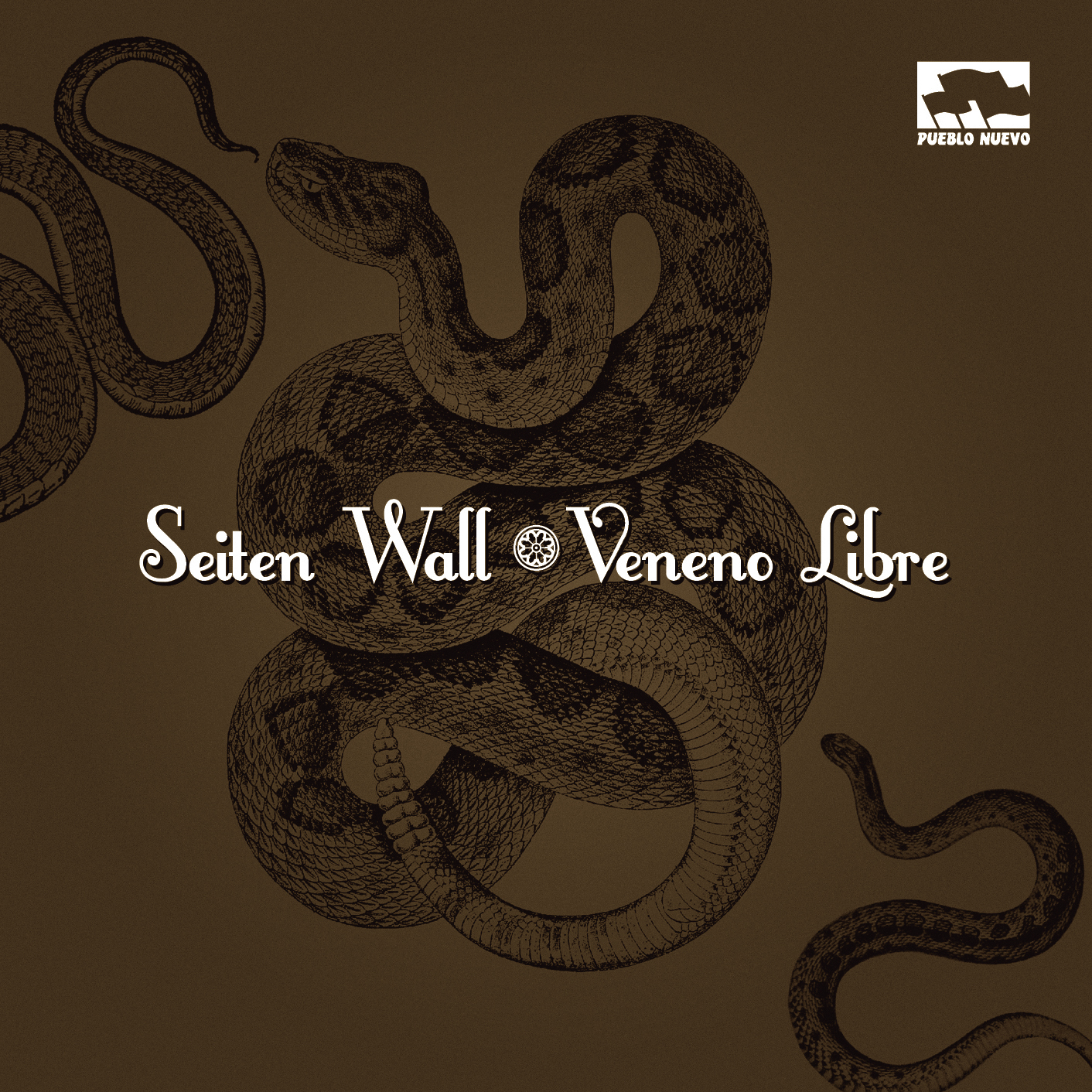
Seiten Wall – Veneno Libre

Seiten Wall – Veneno Libre
[pn174]

Seiten Wall

“Veneno Libre”

THE INDIESCREET CHARM OF THE LEAP INTO THE VOID
(& THE CONSEQUENT TUMBLE)

Each work by the musician and composer Ricardo Tapia (Santiago RM, 1991) constitutes an experience in itself. Not only because of the multiple spaces and aliases he engages, but also through an almost permanent impossibility of anticipating the result. Nevertheless, a panoramic observation of his catalog allows us to distinguish certain inclinations or tendencies, better understood as an emphasis on a certain spectrum or stereo channel, just as an uncalibrated turntable would do in playing some record. This inclination enables a particular listening experience, arranged from that obscuration mentioned by Les Luthiers in “La bossa nostra” (1973)[1].

Like any composer born at the end of the 20th century, Ricardo carries a particular disposition to encompass a constantly expanding sonic environment – that is, increasingly saturated with information, storage technologies and timbres / colors. This can make it difficult to access the totality or corpus of the trajectory to be covered from what he draws or announces at the outset. On the contrary, we instead find ourselves with scraps, bits, zapping and clippings that intersect, interface[2] and metamorphose into the unspeakable, devoid of all control, prompting us to «turn off the mind, relax and float downstream» or to leave «running for our lives, if we can”[3].

In this sense, his complete work is an offering analogous to the aesthetics of the New York radio station WFMU, which does not seek to keep the listener captive, but to test the listener to the point of exasperation, to the point of turning off the radio or changing stations. In the case of “Veneno Libre” (Free Venom), we find a plunderphonic approach that is not afraid to approach from the Latin American perspective those areas of exasperation present in works like those of the concept’s originator (the Canadian John Oswald[4]) or in works by visual artists such as Britain’s Vicki Bennett (aka People Like Us).

The material taken can be manipulated or not, in an act of not doing (laissez-faire) usually punished by compositional schools that castigate the pleasure of “doing nothing”, as laziness that must be eradicated like the plague. The routes that originate these pieces constitute trial and error in its purest state, an approach also punished by these and other schools. In this transit, the tumbles do not cease to be and must be felt, with the greatest force, surpassing those alluded to by Carlos Cabezas Rocuant in “El frío misterio (The Cold Mystery)” (1987), becoming “honorable scars of war”, as is sung in one of the first stereophonic records recorded in Chile[5].

Thus, jumping into the void with the vocation of a stunt double, channeling as much reference as he is capable of amplifying, erasing stylistic boundaries with his computer like a child armed with pencils and university notebooks – and, incidentally, throwing the whole world on top, in -voluntarily-, Ricardo Tapia, in his Seiten Wall character, presents himself to us as a local counterpart of the beloved Rubén Albarrán, as a counter-mirror to the Chilean-German Uwe Schmidt, pushing as far as he can the always correct limits of the local sonic musical scene.

[1] See https://lesluthiers.org/verobra.php?ID=42 and https://youtu.be/RsoeDiu8veg. Accessed October 25, 2020.

[2] See the interview with Luis Alberto Spinetta (1950-2012) conducted in Santiago RM by Nelson Peña González in 1986 (minute 22 and forward): https://archive.org/details/lasintrvws/. Accessed October 25, 2020.

[3] Excerpts from “Tomorrow Never Knows” (1966) and “Run For Your Life” (1965), respectively.

[4] See his essay “Plunderphonics, or Audio Piracy as a Compositional Prerogative” (1985) in http://plunderphonics.com/xhtml/xplunder.html. Accessed October 25, 2020.

[5] Excerpts from “Los viejos estandartes”, (1966), track B1 from the Los Cuatro Cuartos album ¡Al “7° De Línea”!. See https://www.discogs.com/Los-Cuatro-Cuartos-Al-7-De-L%C3%ADnea/release/4795083. Accessed October 25, 2020.

Gerardo Figueroa Rodríguez
(Maipú, Chile. 25 octubre 2020, horas antes de votar #apruebocc / October 25 2020, hours before voting #apruebocc)

Button: by-nc-sa
posted 30 November 2020

ESDLCP – Historial de Caidas Remastered

ESDLCP – Historial de Caidas Remastered
[pn171]

ESDLCP

“Historial de Caidas Remastered”

A series of misapprehensions tie me up to this record. The first time I read about José Manuel Cerda, I thought that a homonymous colleague, expert in Middle Ages History, had decided to unveil an unknown musical side. After downloading Doble ola EP, I thought this was his first album, strongly recommended by Richi Tunacola (“one of my Desert Island Discs”). That was the work I wholeheartedly agreed to review (“I love it”, I doubtlessly replied) and that, when I started listening to it, I wasn’t able to recognize it at all. I headed towards my 30-year-old list of cassettes and compact discs to confirm this was the first time I listened to Historial de caídas, indeed.

I’m aware of this unforgivable confusion in an era we are able to check almost every data on the music we listen to, unlike the 80s, when most of the times we thought the name of a band to be the name of a solo artist or an album, or that Rick Astley’s voice belonged to an unmistakably African-American singer instead of a pale, red-headed fellow. But these interferences and entanglements may also belong to a time when, in a couple of minutes, we are able to download a catalog it would have taken years to complete otherwise, a time when we listen to such an amount of songs it is almost impossible for us to learn their lyrics by heart.

I’m starting to think it’s a mistake to mention all of this, for I suppose José Manuel Cerda is much younger than I am. Wrong again: we are the same age. Maybe this is not a mistake. Maybe the beauty of a collection called Historial de caídas (Tumbling Records) is, precisely, the vindication of error, diversion, and failure, trying to find a room and meaning for all of them. And this is the very gesture reinforced by this new release: at a time when the whole world around seems to collapse, not just our little lives, the traces of light these compositions offer resonate in a paradoxically hopeful manner.

This is also a self-reflective memory exercise of an album that turns out to be ten years old, but also the samples’ contained coming from long ago. I ask José Manuel, (although I’m not sure to call him by his real name, or El sueño de la casa propia, or Bruxista), about some of the audio references. He mentions Michael Jackson, The Flaming Lips, Nelly Furtado, David Bowie, Shellac, among other FLAC files inside a folder: “they were not just favorites, there were also rarities or mainstream pop records, raw material for extracting meaningful loops to construct a sonic building around, according to what they suggested”. These buildings, by the way, resemble Neto Iturrieta’s collage structure used as a cover for the first release, their elements flexibly and precariously combined, like an ephemeral piece of architecture.

If I’ve listened to Historial de caídas in 2010, I may have indulged in comparisons with other cratedigging/cut ‘n’ paste masters, such as The Books, but now I pay much more attention to some of the tracks tribal power, rhythms almost flirting with our very own cueca. I think the “latinamerican” label sounds kinda cliché, but it may properly apply here. I’m still listening to it on a cold, silent morning, through a spring afternoon, interrupted from time to time by a neighbor’s drill. Maybe that drill could be sampled. This makes me think about what would happen if we heard it coming through this record. And I listen to it once again, till becoming one of my Desert Island Discs.

Felipe Cussen
(Santiago, Chile. Octubre / October 2020)
English version by Gerardo Figueroa.

Button: by-sa
posted 30 October 2020

Laurent Fairon – Chant de Naufrage

Laurent Fairon – Chant de Naufrage

Laurent Fairon

“Chant de Naufrage”

New, Bandcamp-exclusive album.
11 tracks, 64mn, free download.

These tracks came to life growing on pre-existing musics like epiphytes do on plants or trees. Found herein are excerpts and samples from 78rpm laughing record, operatic singer, 20th century contemporary musics, YouTube detritus, etc, as well as a flotsam of electronic loops, synth sounds and the omnipresent human voice, especially wordless female vocals – hence the title ‘Chant de naufrage’, French for Hymn of Wreckage.

File under experimental-ambient, post-industrial, musique concrete, collage

LF: records, samples, virtual synth
Recorded 2019–2020

Button: by-nc
posted 10 September 2020

G-cero – No Tienen Necesidad de Hacerlo

G-cero – No Tienen Necesidad de Hacerlo
[pn163]

G-cero

“No Tienen Necesidad de Hacerlo”

Greyhead, a.k.a. “G-cero”, shares his new EP “No tienen necesidad de hacerlo” (No Need For It), originally premiered a few blocks from Plaza Dignidad(*) in October 2019, in the midst of Chilean upheaval, also offering help, support and relief to those in need.

Since 1973’s coup d’état, carried out by the US government in conjunction with Chilean Armed Forces against Presidente Allende’s Unidad Popular, there was no more freedom for people again: they set up a new Constitution, invented Pension Fund Managers and Private Health Funds, our jobs became precarious, imposing a neoliberal economic system that has privatized almost everything, in a state terrorism context, using torture, disappearance, and exile.

Since returning to this “compromised democracy” in 1990, franja del NO campaign promises of change became dust in the wind. As singer-songwriter Jorge González, quoted in one of the tracks of this record, said in 2011: “They have the law supporting them: the whole press, the media, the police, and the army, if everything else fails; and that last resource won’t ever fail». This was a self-fulfilled prophecy during Chile’s awakening on October 18. The government invoked anti terrorist law, the press blatantly lied in radio, TV, and newspapers; the police shot straight to the eyes of the protestors, the army went out to kill, just like President Sebastián Piñera proclaimed: “We’re at war”. Thus the Chilean ruling elite, headed by one of the 5 richest Chileans in the world, according to Forbes magazine, faced this upheaval. But this time they were not able to use their power single-handedly: the whole world was watching, via social networks and the millions of cameras every single person carries in their pockets, what was really happening in Chile – an impossible thing to do in the 80s. If the “aliens” and “the front line”, haven’t met every Friday at Plaza Dignidad and other key spots along the country, our politicians wouldn’t have ever thought about trading the coming elections for changing the Constitution for a new one, allowing us to live in a real democracy.

This record is an open mic sonic experiment, recorded at Plaza Dignidad during October demonstrations, later processed in an experimental EP, where G-cero mingles this whole revolt in refined waves, glitch sounds, envelopes, powerful bass drums, arpeggios, ambient hi-hats, assorted samples and noise loops. All of this following the rallies beat.

Felipe Baradit Stevenson
(Concón, Chile. Agosto / August 2020)
English version by Gerardo Figueroa.

Button: by-nc-sa
posted 24 August 2020

abenrml – [不可能的全息圖]

abenrml – [不可能的全息圖]
[VSS106]

abenrml

“[不可能的全息圖]”

abenrml is back to Virtual Soundsystem Records with another experimental LP, a monolith of noises and weird sample manipulation ideal for plunderphonics and noise fans.
Enjoy!

“This album is… dense. There are many layers… like an onion! The title [不可能的全息圖] (roughly: “Impossible Hologram”) ties in thematically with some of the samples, but also the concept of the album itself. The relation of the tracks to one another, and the way in which much of the sonic landscape was generated. In that sense, the music is a kind of metaphorical hologram. It is centered around track four, both literally, and figuratively. This is a very old recording I made, from perhaps as early as 2013.

It would not be easy to create this with anything other than a computer. In many ways, this is a thematic follow up to my earlier album, [在常情節中找到自己], (or: “Finding Oneself in the Routine Plot”). However, it is also an effort to bridge the gap between my earlier “career” as a noise artist, many years ago. At that time, I was very interested in the idea presented in the album Zaireeka, by the Flaming Lips. Taking a track from that period of my discography, and making an homage of sorts, also blending it with my current influences is what has resulted in this collection of recordings”.

– abenrml

Button: no
posted 23 August 2020

CLOUDWARMER – The Happening At Groom Lake

CLOUDWARMER – The Happening At Groom Lake

CLOUDWARMER

“The Happening At Groom Lake”

SYMPTOMS
Shortness of breath
Anxiety
Trembling
Feelings of terror
Panic
Rapid heartbeat

If you have _____, you aren’t just uneasy with the thought of ______. You have a persistent fear and anxiety related to it possibly affecting your life.

The symptoms of _______ are similar to those of other common phobias, which include:

______ can cause some symptoms that are similar to those of other phobias, as well as some that are unique. Sweating, shaking and crying may occur during a thunderstorm or even just before one begins. You may seek constant reassurance during the storm. Symptoms are often heightened when you are alone.

Additionally, many people with ______ seek shelter beyond normal protection from the storm. For example, you may hide under the covers or even under the bed. You may go to the basement, an inside room (such as a bathroom) or even a closet. You may close the curtains and attempt to block out the sounds of the storm.

Another fairly common symptom is an obsession with weather forecasts. You may find yourself glued to the ______ during the rainy season or tracking storms online. You may develop an inability to go about activities outside your home without first checking the weather reports. In extreme cases, _____ can eventually lead to you being afraid to leave your home.
credits
released August 14, 2020

Eddie Palmer
Brett Zehner

Button: by-nc-nd
posted 18 August 2020

Tha Silent Partner – BOXLUNCH: Sweet Nectars, Creampies And, A Napkin To Wipe Your Mouth With

Tha Silent Partner – BOXLUNCH: Sweet Nectars, Creampies And, A Napkin To Wipe Your Mouth With
[BSOG0091]

Tha Silent Partner

“BOXLUNCH: Sweet Nectars, Creampies And, A Napkin To Wipe Your Mouth With”

Here we have the great new album by Tha Silent Partner… BOXLUNCH: Sweet Nectars, Creampies And, A Napkin To Wipe Your Mouth With. Thirteen tasty new joints for you dirty, dirty pervs to bump loud. Dope music… don’t overeat. However, we know you will…

You did it again, TSP! More fire. You steady keeping your fans spoiled. Thank you, sir!

Of course, thanks once again to you for downloading & listening. We always strive to deliver the music you’ll love. Please spread the word about blocSonic, if you enjoy what we do. Remember… everything we release is cool to share! Always keep the music moving… share it… blog it… podcast it! If you’re in radio… support independent music and broadcast it!

Button: by-nc-sa
posted 21 July 2020

ESDLCP – Historial de Caidas

ESDLCP – Historial de Caidas
[pn058]

ESDLCP

“Historial de Caidas”

(10 YEARS ANNIVERSARY OF THE RELEASE)

“Could an electronic musician become a pop artist? ‘Historial de Caídas‘, ESDLCP official debut is a statement in that sense: album and composer prove a style naturally leaning towards in-vogue pop music, using collage to create songs filled with non-existing choruses.

Throughout ten tracks, ESDLCP grabs assorted electronic resources to set up and disjoint material. There’s room for programmming, sampling, jamming, and deconstructing here. Everything merges into popular-music-crossing soundscapes, taking listeners into a tour of varieties, styles, and realms: toying with calm moods in ‘Puertas Adentro’, glancing to our folk music in ‘Un paso al costado’, and even flirting with rock music in ‘Cortina de Humo’, ending up with a high quota of pop in ‘A la velocidad del amor’ and ‘Voluntad de oro’.

This diversity sets up an endearing mapping, a fragmented, nice whole, mixing in subtlety all-pervading electronica and organic fantasies. Measured-Pop doses, songs and schemes in harmony, electronic music communicating, trespassing. A healthy way for this José Manuel Cerda solo project, where transforming song as a standard into an in-flux art is taken to exhaustion.”

Felipe Mardones
(Santiago, Junio / June 2010)

Button: by-nc-sa
posted 16 June 2020

SPIEDKIKS – A POMPOUS WHIMSY PEAK

SPIEDKIKS – A POMPOUS WHIMSY PEAK

SPIEDKIKS

“A POMPOUS WHIMSY PEAK”

A Pompous Whimsy Peak is the fifth Creative Commons licensed studio album by Spiedkiks. It was produced and recorded on and off between January and April 2020.
Originally intended to be a dusty downbeat record to celebrate, in combination with the fourth studio album Super Constellation (Oct. 19), our 10th anniversary, the recording took place at Spiedkiks’ home studio in Cologne, Germany.

All songs written, produced mixed & mastered by Spiedkiks
Recorded at Spiedkiks’ home studio in Cologne, Germany
credits
released May 1, 2020

Extra supa thanx to
Mike Gregoire & blocSonic for Design and supporting this release
Kaweh Agah for cover artwork
S. Gellermann & S. Eschbach for inspiration and support

Button: by-nc-sa
posted 13 June 2020